
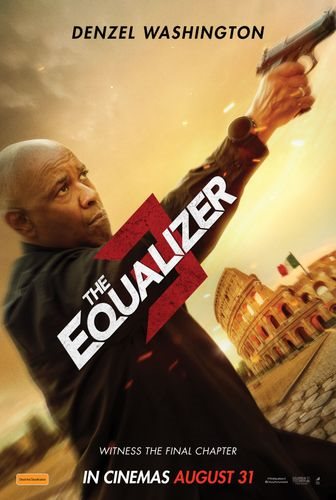
The final entry to Denzel Washington’s thrilling series, The Equalizer 3, is a treat. What separates this film from its predecessors is its tone. While it does not skimp on the violence, it is more obviously a character study than the previous two entries. Where The Equalizer introduced us to Robert McCall and The Equalizer 2 set him on a particular path, we find Robert questioning everything about who he is and what he does. He’s seeking peace now more than ever, but he continues asking himself if he deserves it.
This is not to undermine the thematic elements of the first two films. The question of peace, and whether or not it is deserved, earned, or simply exists, is itself at the heart of this film series. Yet, The Equalizer 3 takes its time to weave a complex set of ideas regarding what it means to be a good person and the ambiguity associated with what we consider reasonable and evil. The conversation is had throughout the film, but it is not always through explicit text. Actions taken by certain characters are used to discuss good and evil, whether through the lens of reality or in service to the story. For example, it’s generally easy to tell a villain from a hero in fiction. Yet, in reality, the situation is not always clear. I can assure you the police and the United States government would view Robert McCall as a villain in the real world – albeit termed as a vigilante. In the world of fiction, we, as the audience, know he’s a hero. Leading this entry alongside Denzel Washington is Dakota Fanning as Emma Collins and Andrea Scarduzio as Vincent Quaranta.
The Equalizer is a fantastic conclusion to this trilogy, and each film proved better than the last, in my opinion. Being able to watch them close to one another, the threads that connect them become more apparent. Even if the majority of the supporting cast does not return from one entry to the next, it doesn’t make their impact any less felt. Robert McCall’s long-standing friendship with Susan Plummer (Melissa Leo) is not forgotten; it is honored without going into too much detail. The ultimate fate of Brian Plummer (Bill Pullman) is not firmly addressed. Still, one can only hope that after the second film’s plot was wrapped up, he could come back to what remained of his life. Finally, Robert is still helping those in need, whether they truly know him or have met him in passing. We don’t need the return of those he helped earlier to see that he is on the same path. It’s conveyed perfectly throughout the film.
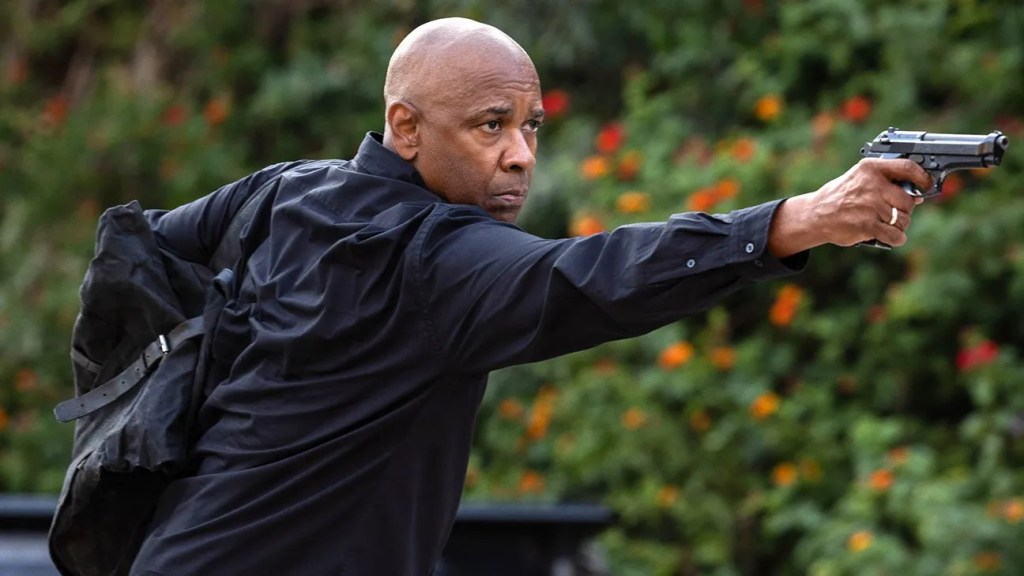
While The Equalizer and The Equalizer 2 spent predominantly their entire story within Boston or the confines of the United States, The Equalizer 3 is set almost entirely in Italy. Specifically, a small coastal Italian city by the name of Altamonte. While there is an actual city in Italy named Altamonte, here is a combination of the Amalfi Coast and Atrani. Regardless, part of this film’s charm is the beauty of Italy and the community within it that Robert McCall finds himself a member of after his latest mission. We come to know the people of this town, though primarily as a group with a handful of integral characters that represent the whole. This is a movie, after all.
Beginning with Robert having already stormed his way into the base of an Italian mafioso, he successfully executes his target only to end up shot in the back, surprisingly, by a child. In one of the only injuries he sustains throughout the series, we soon watch him deal with the fallout of such a painful wound and the resultant recovery time. Found by a carabinieri, Gio Bonucci (Eugenio Mastrandrea), after passing out from the pain and blood loss, Robert is brought to Altamonte, where the local doctor, Enzo Arisio (Remo Girone), asks the all-important question: “Are you a good man.” Robert’s answer is that all Enzo needs to know is to risk it all to help a man he does not know, in the same vein that Robert has helped countless people in need.
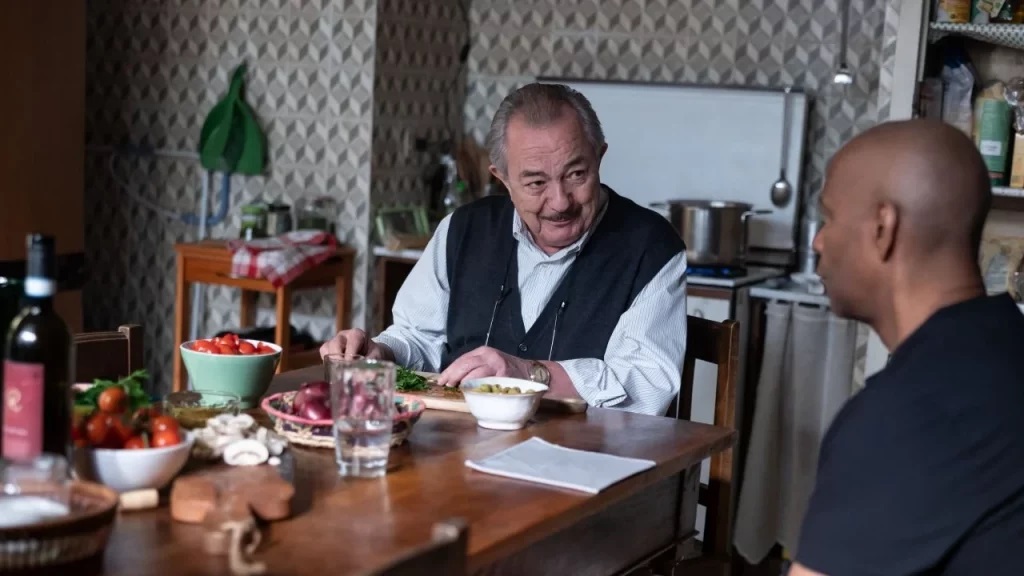

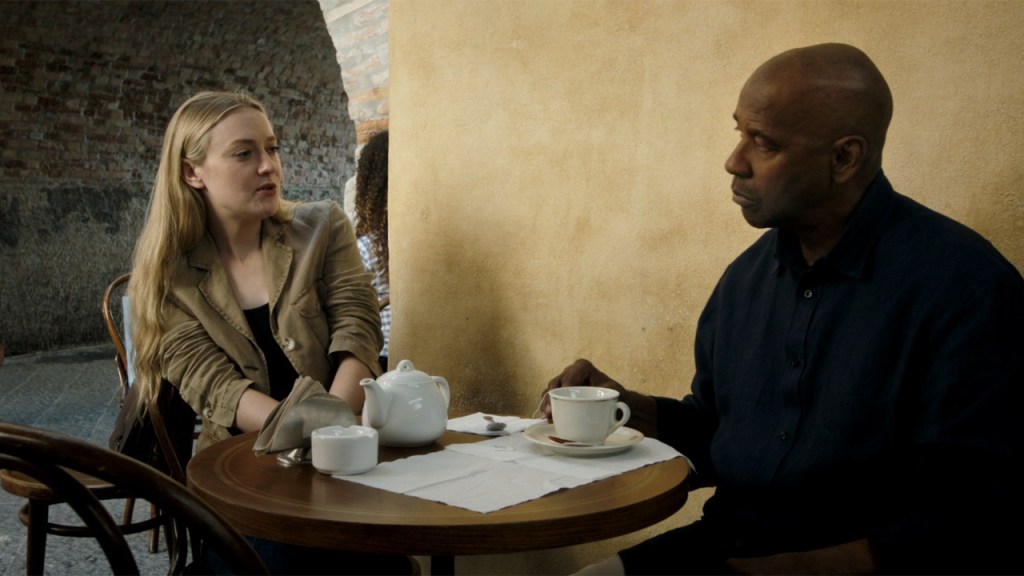
He meets the townspeople during his recovery and slowly pulls himself back together. At first, they treat him with basic respect, though they impart their own wisdom (or judgment) on him because he is an outsider. We see this most clearly through two interactions. First, after Robert is finally able to make it down to the plaza, he finds a quaint little café and orders tea, which is his drink of choice and the only thing we have truly seen him drink throughout the entire series.

Aminah (Gaia Scodellaro) playfully chastises him that only old ladies drink tea and serves him a cup of coffee instead.
The next instance is played immediately after that when Gio formally introduces himself to Robert and calmly informs him that “these are good people” and that he’s parked Robert’s car behind the station without looking into it further. It is as polite a way of saying, “You don’t fit in here; please leave as quickly as possible,” without being rude. Of course, Robert still needs some time to recover, so he doesn’t leave right away, and we see the change in the relationship between Altamonte and Robert.
By the time the villains introduce themselves as a threat to Altamonte, Robert has only a passing attachment to the town that has safeguarded his recovery. The people have already started to embrace him as a member of their community. They view him as one of them. We see this through a kindly old woman who continues to speak with him as he makes his way through the never-ending stairs that are built throughout the tiered city, through Angelo’s (Daniel Perrone) gentle refusal of Robert’s money for an order of fish, and when Aminah playfully mentions that Stefano (Niccolò Senni) finally sold the hat that Robert is now wearing, right after giving him a helpful pointer on how to identify healthy, fresh fish.

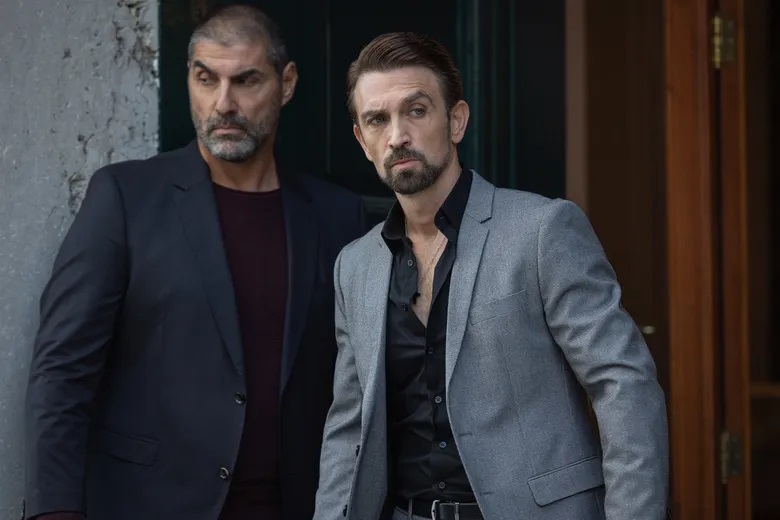
Robert is still resistant to the community, though he is as neat and polite as he has always been because that is just the kind of person that he is. The first time Robert crosses paths with Marco Quaranta (Andrea Dodero), Robert physically stops himself from getting involved. He’s still recovering, and he doesn’t view it as a problem that he should necessarily address. It’s his nature to want to get involved, though. His recovery forestalls any action, allowing the situation within Altamonte to escalate. However, these little moments with the people of Altamonte are woven throughout the film’s first half. They allow us a true sense of the community that Gio and Enzo strive to protect. Even as their situation becomes more transparent to us as the audience, through Angelo’s eyes, we see that they are trying to deal with it on their own. The villains’ impatience and intransigence cause them to cross paths with a violent man they never should have. Because Marco has seen Robert walking with a cane and otherwise infirm around town, he mistakes him for a frail, older man. True, aside from Robert’s initial massacre, he is incapable of acting violently until over half of the film is over, making it so much easier to underestimate him. The audience knows better. Once Marco and his goons come into conflict with Robert, their story effectively ends in five minutes.
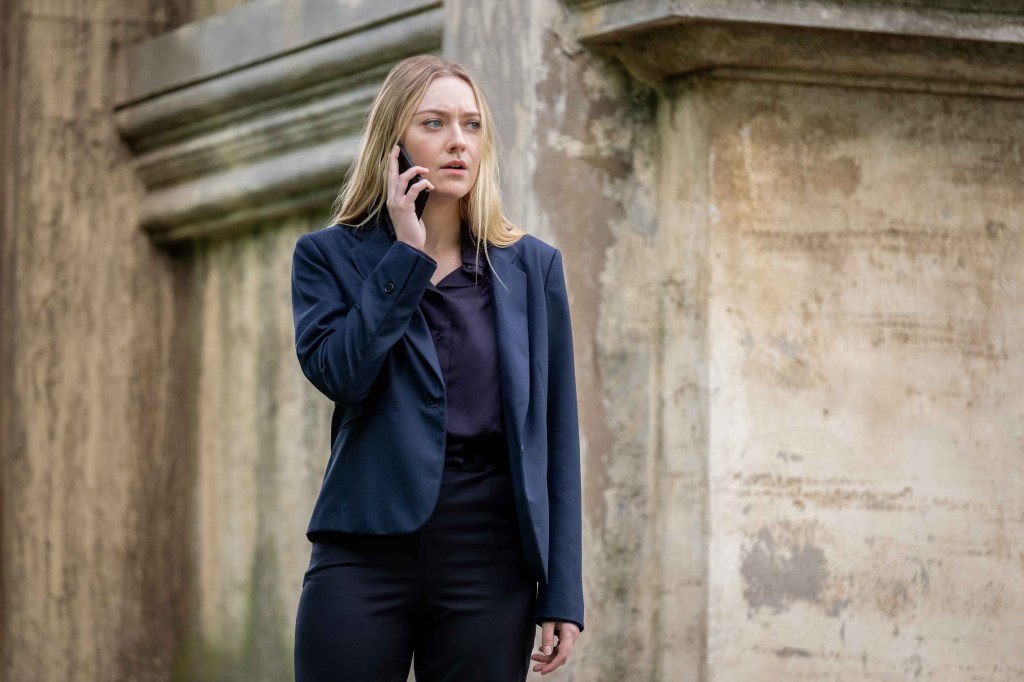
The problem, of course, is that Marco is the younger brother of the head of a Camorra, the Italian Mafia. Vincent Quaranta (Andrea Scarduzio). In what would typically be a fearsome and effective villain, we know that nobody can effectively counter a man like Robert McCall. This is what made the character of Emma Collins (Dakota Fanning) an interesting addition. Reuniting Dakota Fanning and Denzel Washington for the first time since 2005’s Man on Fire, it’s as if we are seeing a stealth sequel after all these years. Emma is a CIA officer who focuses on financial transactions that lead to the exposure of larger criminal operations. Robert’s initial operation drew her and the CIA into a bigger conspiracy that is hysterically connected to the Camorra’s plans in Altamonte. Emma is not the unbreakable force that Robert is, and her investigation ruffles the feathers of those involved in this conspiracy. If it is not for a timely phone call, we see how easy it is to kill somebody not named Robert McCall.
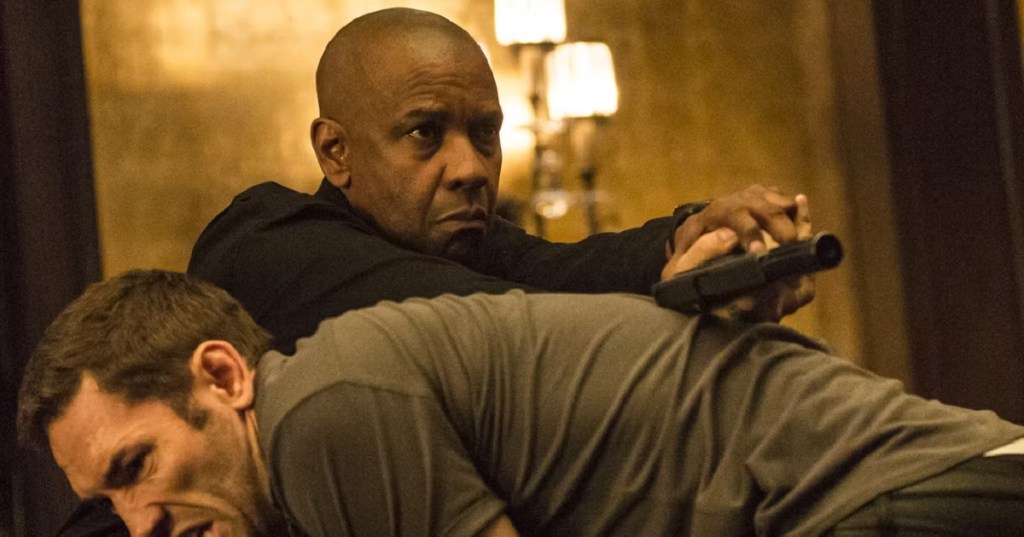
The fact that Vincent and Emma never share a scene is more realistic than we would usually see in a film. The kind of investigations in which the CIA involves themselves are typically run this way, with others on the ground tackling the finer aspects. Emma lays the groundwork, and agents would have dealt with Vincent if given the chance. It’s just in their good fortune that Robert is there to solve it for them because they threatened that which he holds dear.
Regarding the final members of the supporting cast, we have Chiara (Sonia Ben Ammar) and Gabriella Bonucci (Dea Lanzaro), Gio’s wife and daughter, who mean the world to him. Members of Vincent’s team, including Lorenzo Vitale (Bruno Bilotta) and Viking (Alessandro Pess), fill out the ranks of the Camorra. However, there is a litany of them that do little more than threaten those around them and die. There is also Chief Barella (Adolfo Margiotta), who the film wastes no time painting as a villain way over his head. They weave in and out of the main storylines, filling out the world as Robert cuts through the meticulously created plan laid out by Vincent in a handful of days.
The Equalizer 3 was designed to close out the story of Denzel Washington’s Robert McCall. It builds a comfortable new world for him to exist in and feel a part of after he has finally come to terms with those he has lost. They cannot replace his wife or Susan, but they can fill his heart and remind him that life is worth more than blood and honor – it can have love, warmth, and community – if you let it.
 Lloydd Marshall Books