

There was a time when the action-adventure film was the go-to genre for the summer blockbuster. That window between May and September, when one could expect a slew of films to come out with big budgets, revolutionary CGI, A-list ensembles, or then up-and-comers, and everything that we came to associate with it was at our fingertips.
In the modern era, we still have those films, but they are often fighting against the spotlight which has stubbornly been placed on the comic book superhero genre, which can run the gamut of subgenres in the same series.
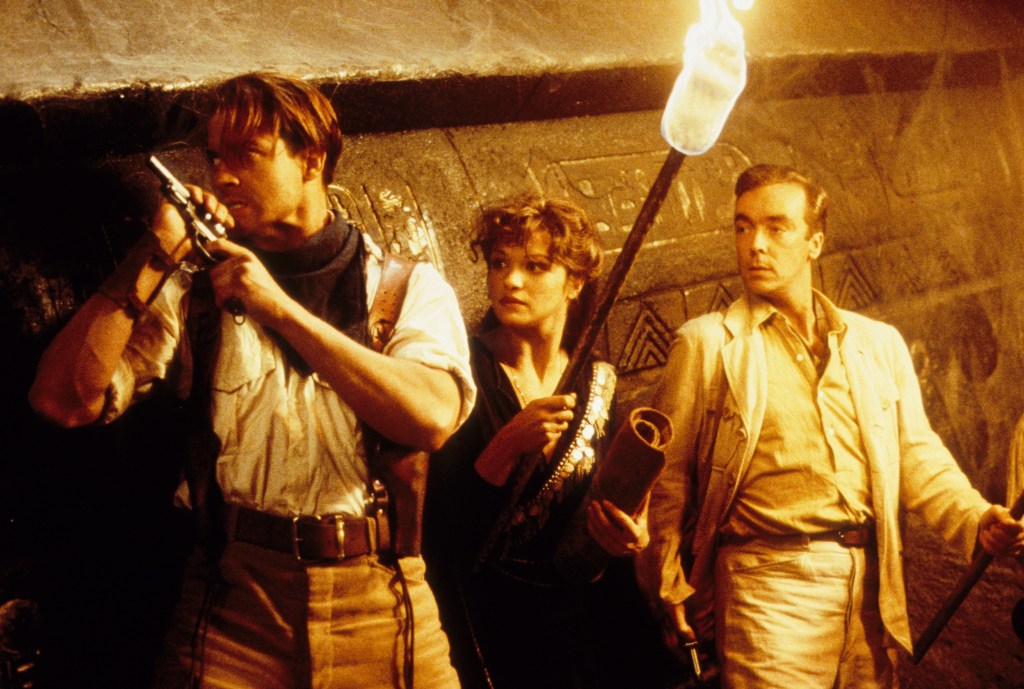
The Mummy, a remake of the 1932 Universal Monsters film, was one such film. Starring Brendan Fraser and Rachel Weisz as Rick O’Connell and Evelyn Carnahan, a swashbuckling American adventurer, and a conservative, shy but enthusiastic librarian, traverse across Egypt to solve the mystery of a box that could lead to great treasure – or great death. The Mummy primarily takes place in the 1920s, but in its first ten minutes, we are party to two prologues to set the stage for the story as a whole. If a third time skip of any length had been used, the introduction of Weisz’s Evelyn could have counted as a third prologue.
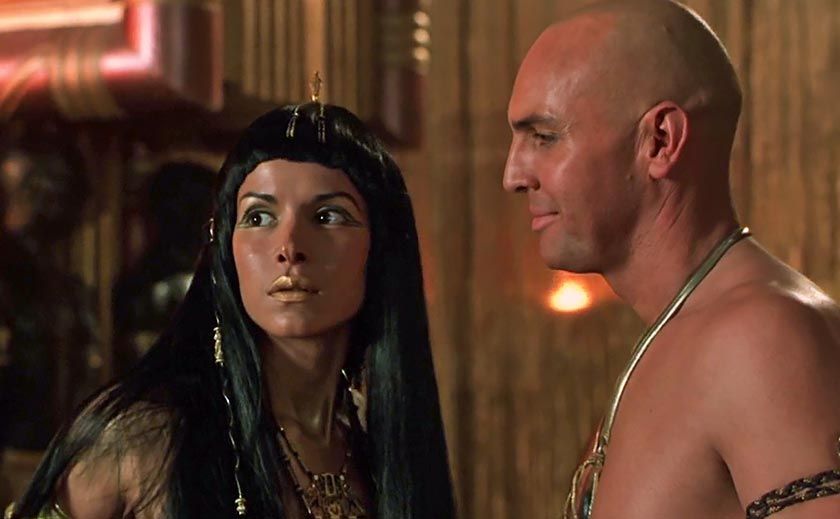
At first, we begin in ancient Egypt, and while some liberties are taken, they are mostly dressing for the story that is going to unfold in 1920s Egypt. We are introduced to the court of Pharaoh Seti I (Aharon Ipalé) in Thebes in 1290 B.C., where his mistress, Anck-su-namun (Patricia Velásquez), is engaged in an affair with Imhotep (Arnold Vosloo). Seti I is so paranoid of anybody touching Anck-su-namun that he painted her entire body so he could know if somebody had. It’s this paranoia which leads to him discovering her relationship. Unfortunately for the Pharaoh, it’s mere moments before Anck-su-namun and Imhotep launch a coup against him. Ultimately, it succeeds, but Anck-su-namun sacrifices herself to give Imhotep time to escape so that he can resurrect her. However, before he can complete the ritual, Imhotep is captured and given a painful death by mummification.

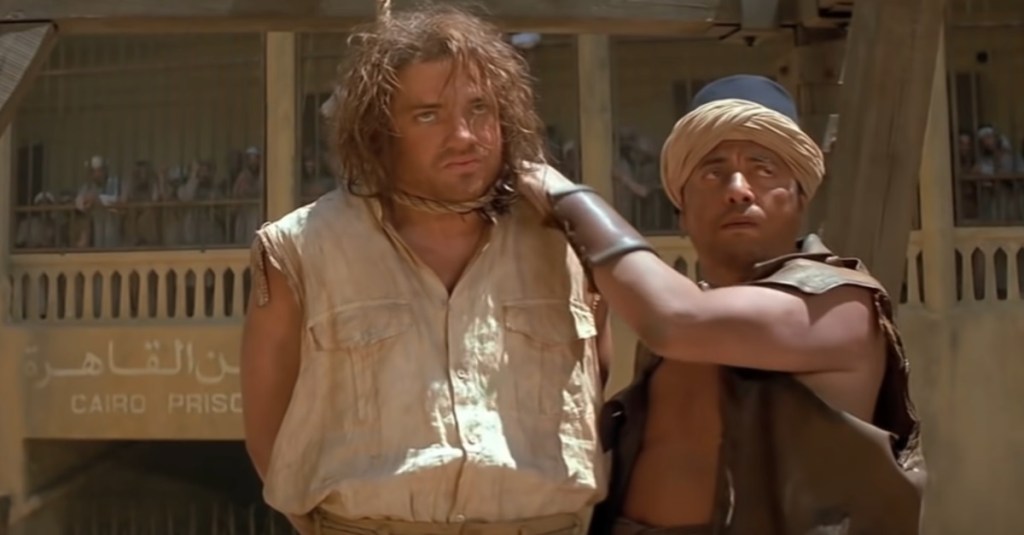
We are then introduced to Rick O’Connell in 1923 as his garrison fights in the middle of the desert. When his people are overrun, and his friend and ally Beni Gabor (Kevin J. O’Connor) abandons Rick to save himself, Rick makes a run for the ruins. Prepared to die, he is stunned to find that his pursuers have broken off, despite having him dead to rights. When we meet him again in 1926, he is set to be hanged – after Jonathan (John Hannah) steals the box which leads to Hamunuptra from him. After a shocking first kiss, he demands that they get him out of being hanged and, desperate/excited to find Hamunuptra, they manage to secure his release by haggling with Gad Hassan (Omid Djalili), the warden of the prison in one of the most humorous scenes. As Rick is hanging for dear life, the pair debate how big of a percentage Gad should get, and when Evelyn suggests thirty, in his effort to best her, he says twenty-five, having clearly expected her to offer something below that.


The Mummy has a vast supporting cast, but chief among them was fan favorite Ardeth Bay (Oded Fehr). The leader of the Medjai, the “modern” day descendants of the former bodyguards of the Pharoah, who have seen fit to protect the secrets of the Ancients.
Mainly, that means keeping people as far away from Harmanuptra as humanly possible, though, for obvious plot-related reasons, they let Rick walk away with the expectation that the desert would kill him. Ardeth Bay and Dr. Terrence Bey (Erick Avari) are adaptations of characters from the 1932 entry, though, in this iteration, Ardeth is not the disguised form of Imhotep but a heroic figure determined to keep the priest from rising from the dead and continuing his evil plans. Dr. Terrence Bey is introduced as Evelyn’s boss, who foolishly sets the map to Harmanuptra on fire – granted, the revelation is over twenty years old. However, he is actually a member of the Medjai, too, and his reasoning is far too obvious when that is made apparent.

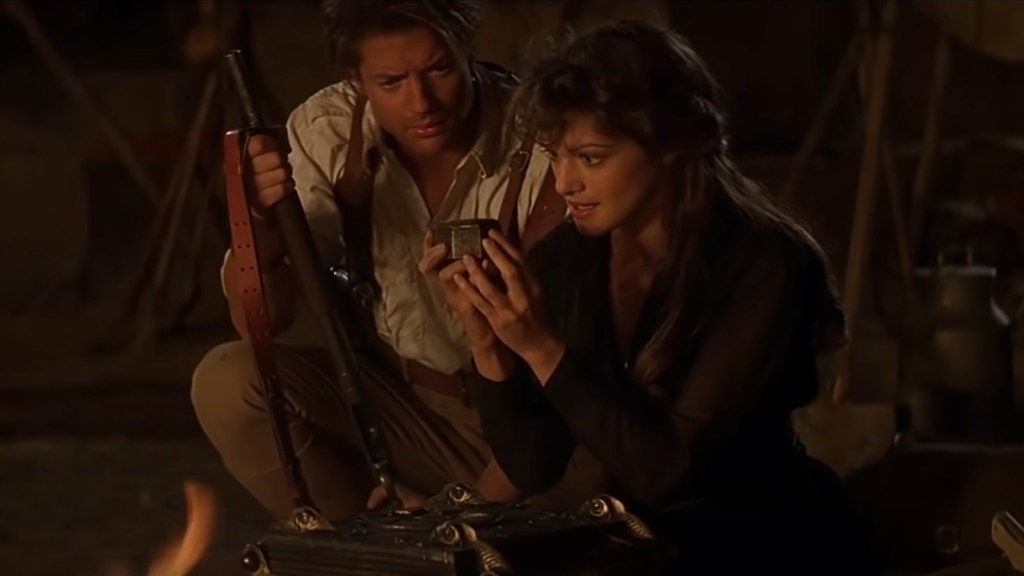
Anck-su-namun, while playing a supporting role this time, is not just the object of Imhotep’s desires, blindly driving him down a path of villainy. Rather, she is presented as Imhotep’s equal partner in this film, and her resurrection is simply a goal along the way to their ultimate aims. While she does not get much screen time here, what Patricia Velásquez does with it is phenomenal. The relationship between Anck-su-namun and Imhotep and Evelyn and Rick are foils to one another – darkness and light, and this concept was further explored in the first sequel for obvious reasons.
The major supporting characters are the men who are a part of the expedition to and into, Harmanuptra. The Americans, as Evelyn and Jonathan are loathed to describe them throughout their time on screen, are hilarious caricatures of varying kinds of American men, from the brash cowboy to the snotty intellectual. Dr. Allen Chamberlin (Jonathan Hyde), an Australian-British Egyptologist, is in charge of an expedition running parallel to Evelyn’s, and he is as arrogant as they come and casually dismissive of the men he has brought along to actually conduct the expedition for him. It’s telling that his guide is Beni, Rick’s cowardly friend who abandoned him as quickly as possible.

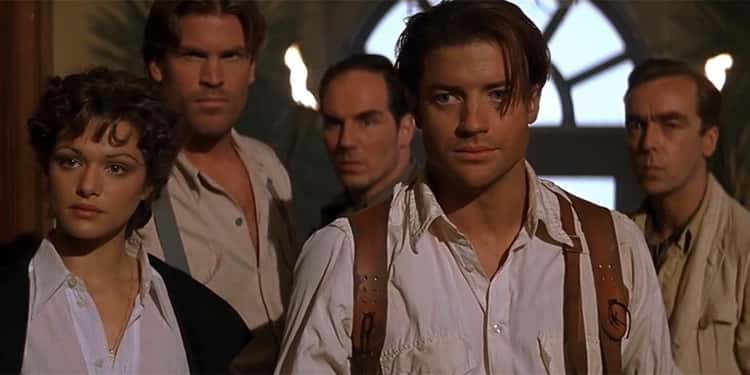
On Dr. Chamberlin’s expedition are the three Americans mentioned above. First, Isaac Henderson (Stephen Dunham) is the stereotypical cowboy, a lover of guns, and their group’s most physically imposing member. Second is Bernard Burns (Tuc Watkins), a bespectacled gunslinger like his comrades; he is more bookish than Henderson – eagle-eyed viewers will recognize him from his long-running supporting stint on Desperate Housewives. Finally, we have David Daniels (Corey Johnson), who is less of a cowboy than Henderson but more of one than Burns. Together, they provide the muscle for Dr. Chamberlin, and each of them pays for it dearly.

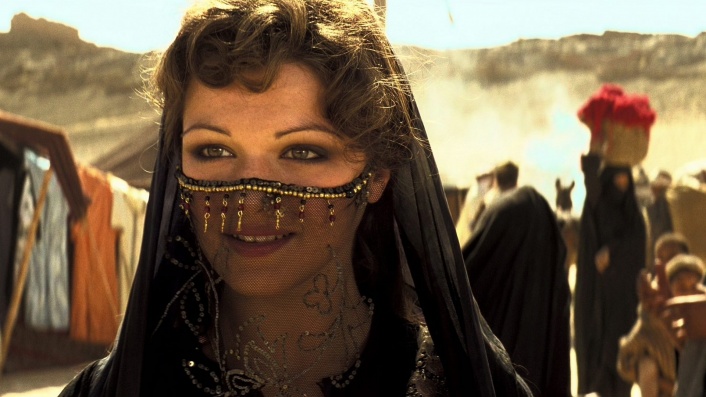
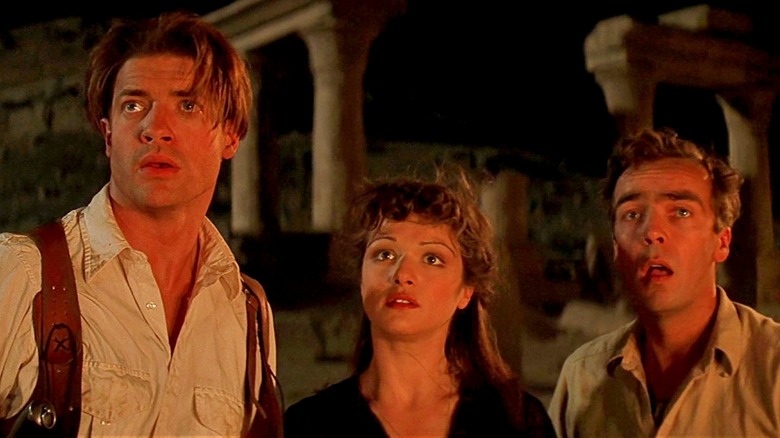
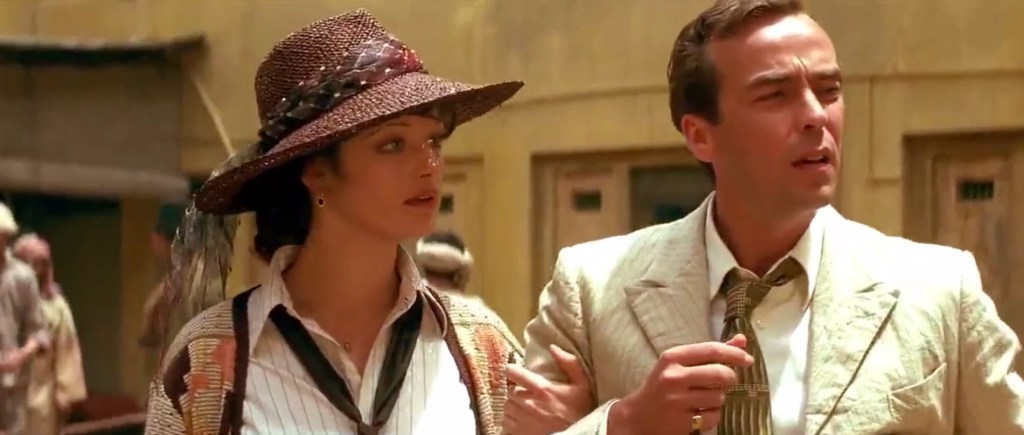
One of the best parts of The Mummy are the relationships between the three primary leads – Evelyn, Rick, and Jonathan. True, Jonathan is a supporting player to his sister and her burgeoning paramour, but he is nonetheless central to the dynamic. Even as romance blooms between Evelyn and Rick, her relationship with her brother is incredibly important to her and vice versa. The decisions that Evelyn and Jonathan make, even if they exasperate the other for their varying quirks, are always in the interest of protecting the other. While Beni and Gad ultimately allow their cowardice and greed to consume them, Jonathan proves up to the task when the chips are down – and he will choose to protect his sister over himself or gold any day.
Rick and Jonathan, for reasons that are obvious from their first on-screen interaction with one another, have a more contentious relationship. But what drives them together is Evelyn and their relationship with her, respectively. This helps to provide a grudging friendship between the two men, though they are always prone to snipe at one another.
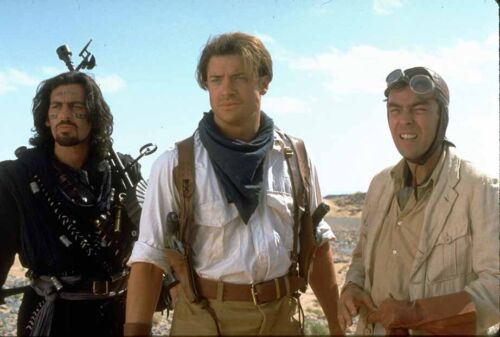
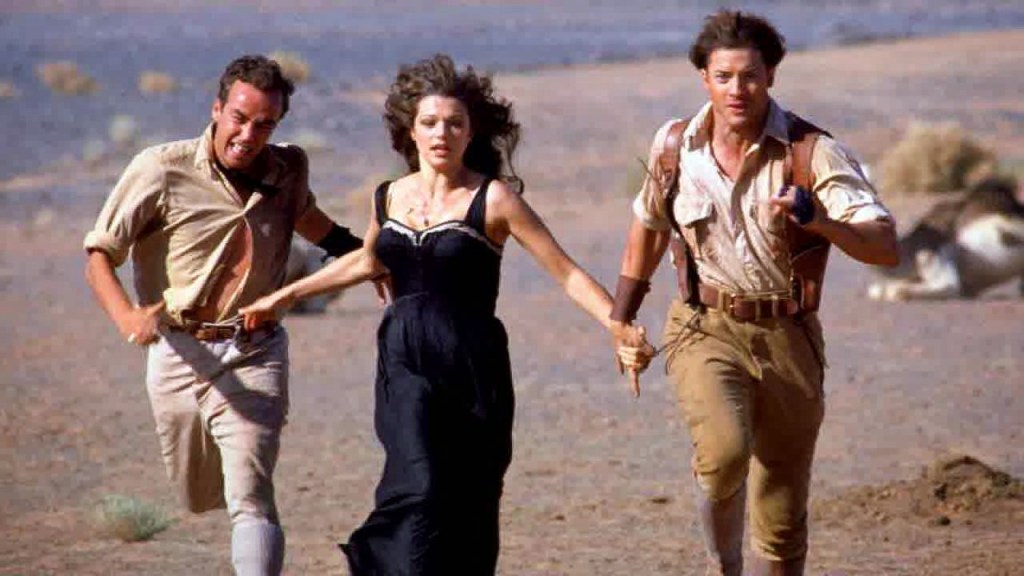
Evelyn and Rick spend much of the film growing closer to one another, and there is never any doubt that their relationship would be official by the end. Watching it happen throughout the film is a true joy – from that brusque first kiss as Rick is certain he is about to die, and her assistance is the only thing that might stop it, to the final romantic kiss before they climb astride their camels and ride off into the sunset.
By now, this is one of the most well-known films to have graced the silver screen. It was always one of those films I could go back and again and watch. The grandiosity of the set pieces lends itself to its ability to be rewatched and find something new. With the benefit of hindsight, certain actions, pieces of dialogue, and even background details take on a larger significance than they might have initially. While this is true for practically every film, The Mummy certainly takes the cake. Obviously, much of the CGI doesn’t stand the test of time, but nothing will ever take away that first, fresh viewing of the film and being awed by its beauty and its scope. Comparing it to today would be like comparing the puppet form of Godzilla of old to the sleek CGI of the 2014 film. It’s an unfair comparison to the natural evolution of technology and its applications.
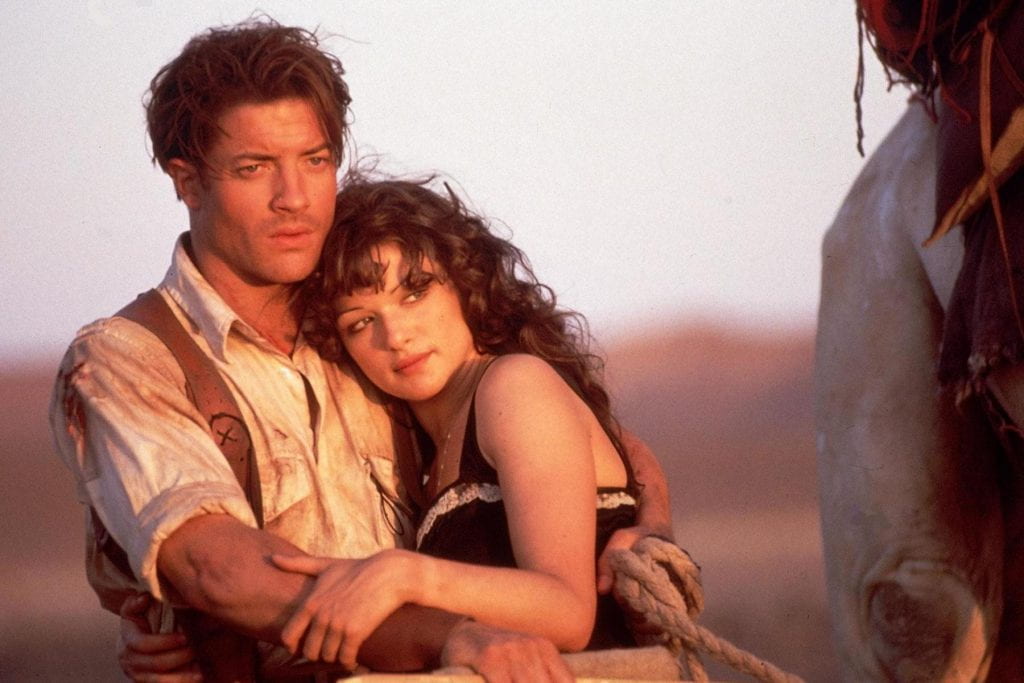
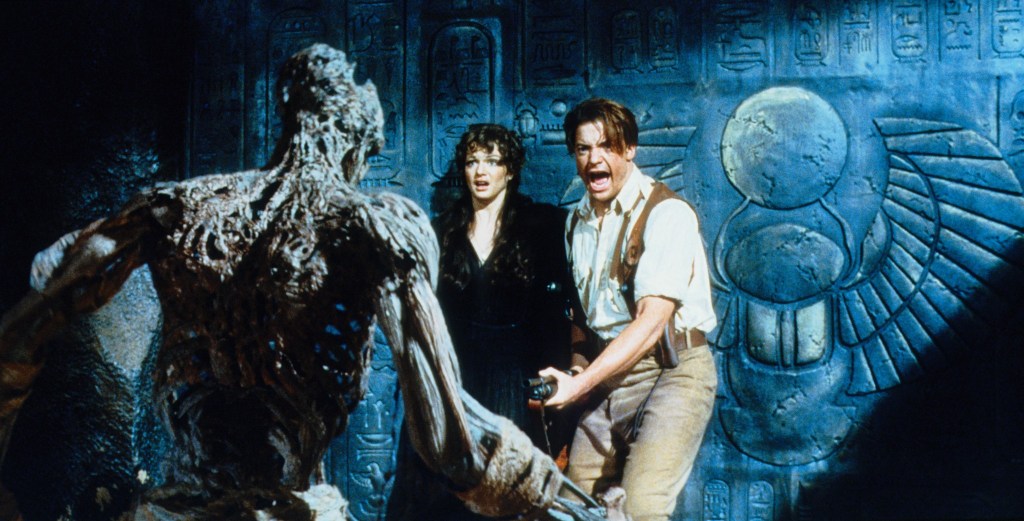
The Mummy is a film wrapped up in a good time, and I highly doubt that there will come a time when I don’t enjoy rewatching it.
 Lloydd Marshall Books
I love this movie, I got to see it in the theater again for the 25th anniversary re-release
LikeLike